
The recommendations for action are a combination of the Infection prognoses and the documented plant protection measures are shown. You can find the recommendations for action at Forecasts -> Recommendations or directly in the view of a virtual weather station. Simply click under Forecasts -> Stations to a station and navigate to the tab Diseases.
How it works 🧪
Before we explain the display in more detail, we first need to get into the theory. Annoying, but it will help you to understand the function better, I promise.
Plant protection products 💦
The VineForecast team has carried out extensive research for each authorised fungicide and compiled a large database from a variety of sources. This database includes information on the efficacy against Powdery or Downy Mildew, the rain resistance or the mode of action of the product. On this basis, estimates can be made as to how long a product will continue to provide protection against the respective fungus under the current infection forecasts.
Recommendation for Downy Mildew
For Peronospora, the first step is to assess whether a product is still present in sufficient concentration on or in the plant. The first step is to check whether the total rainfall since the last spraying exceeds the threshold value for the rainfastness of the agent (in mm). Then it is checked whether the calculated new growth on a main shoot since the last spraying is >450 cm² (for mixtures with potassium phosphonate and for systemic agents >650 cm²). The assumptions for the threshold values for new growth were made based on field trials and are also supported by research from the State Viticulture Institute (WBI) in Freiburg (see here).
Should either Too much rain fallen or too much new leaf area since the last spraying If an infection event is added, it is assumed that the vine is no longer protected from a possible infection. If an infection event now hits an unprotected plant, the recommended action fails and recommends spraying exactly one day before the unprotected infection event (keyword: preventive plant protection).
Recommendation for Powdery Mildew
In the case of Oidium, the new growth since the last plant protection measure is used to calculate the duration of protection. Highly effective agents containing active ingredients such as fluxapyroxad or fluopyram generally have a higher threshold value for new growth than less potent agents such as net sulphur. If the new growth threshold is exceeded and infections are predicted, VineForecast recommends spraying one day before the end of protection, as with Peronospora.
Representation 📊
Recommendations by one virtual weather station
Click under Forecasts -> Stations to a station and navigate to the tab Diseases.
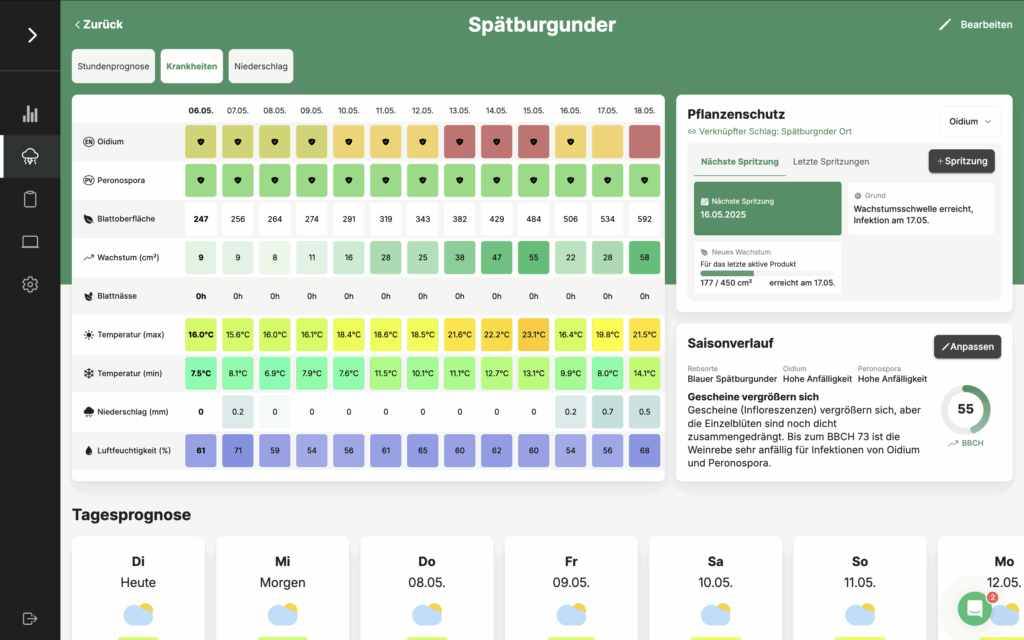
General information on the presentation
In the Diseases tab of a virtual ward, you will find all information on the current infection situation as well as VineForecast's recommendations for action.
On the left-hand side, as in the article on the Infection prognoses The infection status is shown in four colours. Signs above these boxes indicate that the potential infection is protected by existing plant protection products. On the right-hand side of the box Plant protection VineForecast's specific recommendations on the current infection situation can be found here.
Recommended procedure
- In the "Seasonal progress" box, check whether the phenological stage matches the actual situation in the vineyard. If there are deviations, adjust it briefly using the "Adjust" button. This is the only way to ensure that the forecasts for the current seasonal phase are correct (keyword "Oidium window").
- Check the infection situation on the right side for Peronospora and Oidium.
- In the "Plant protection" box, check whether VineForecast currently recommends Peronospora or Oidium (change disease via dropdown at top right).
- Check the threshold values for precipitation and, if applicable, growth.
Based on the illustration above and the procedure described, VineForecast's recommendation for action can now be easily explained:
We first check the phenological stage and realise that this corresponds to reality. So we don't need to do anything else.
If we now look at the top two lines of the infection forecast on the left-hand side, we see colour-coded light infections (green-yellow) forecast for Oidium for the coming days from 06/05 - 09/05. The infection pressure then increases to medium pressure (yellow) between 10/05 - 12/05. A high infection pressure is also expected between 13/05 - 15/05 (red). For Peronospora, no infection (green) is expected for the entire forecast horizon.
Up to 16 May, we see that there is a sign above the infection pressure for both Peronospora and Oidium on all days. This indicates that the vine is protected from these infection events by existing plant protection.
Note: To see which measure still offers which protection for the current infection situation, you can select the "Last sprays" tab in the Plant protection box. The sprayings are taken from the documentation of the field connected to the station.
On 17 May, we see a first infection event with Oidium (medium infection pressure), which is unprotected. If we now take a look at the box on the right and select Oidium as the disease, we see that VineForecast gives a spraying recommendation for 16 May. The new growth limit for the product applied will be reached on 17 May. This is also reflected in the justification provided by VineForecast:
"Growth threshold reached, infection on 17 May"
We could now do the same for Peronospora, although in our example no recommendation is made as no unprotected infection is predicted in the next 14 days.
Summary for all virtual weather stations
If a company owns vineyards that are located in a larger radius, more than one virtual weather station is often created (at least VineForecast Pro required). However, since even then not all parcels are treated individually, but usually all vineyards are treated as a whole, VineForecast summarises them in the combined view under Forecasts -> Recommendations all recommendations about the various stations together.
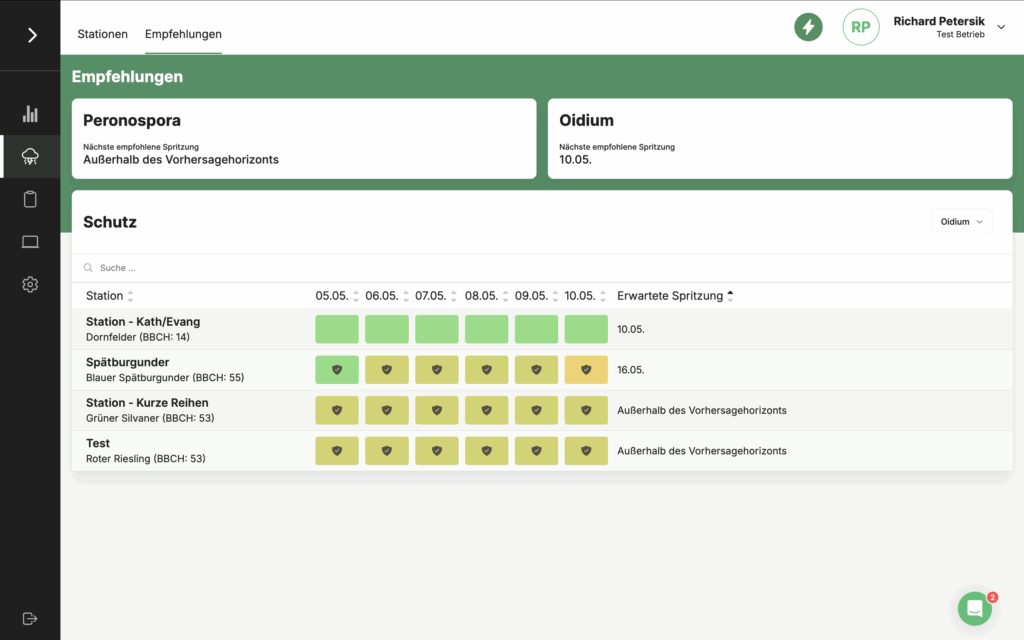
You can see the recommended spraying date for each station in the "Protection" table in the "Expected spraying" column. The earliest date across all stations is then displayed at the top in the "Peronospora" and "Oidium" boxes.